// OPUSJAKE RESOURCE · PROMPT PACK
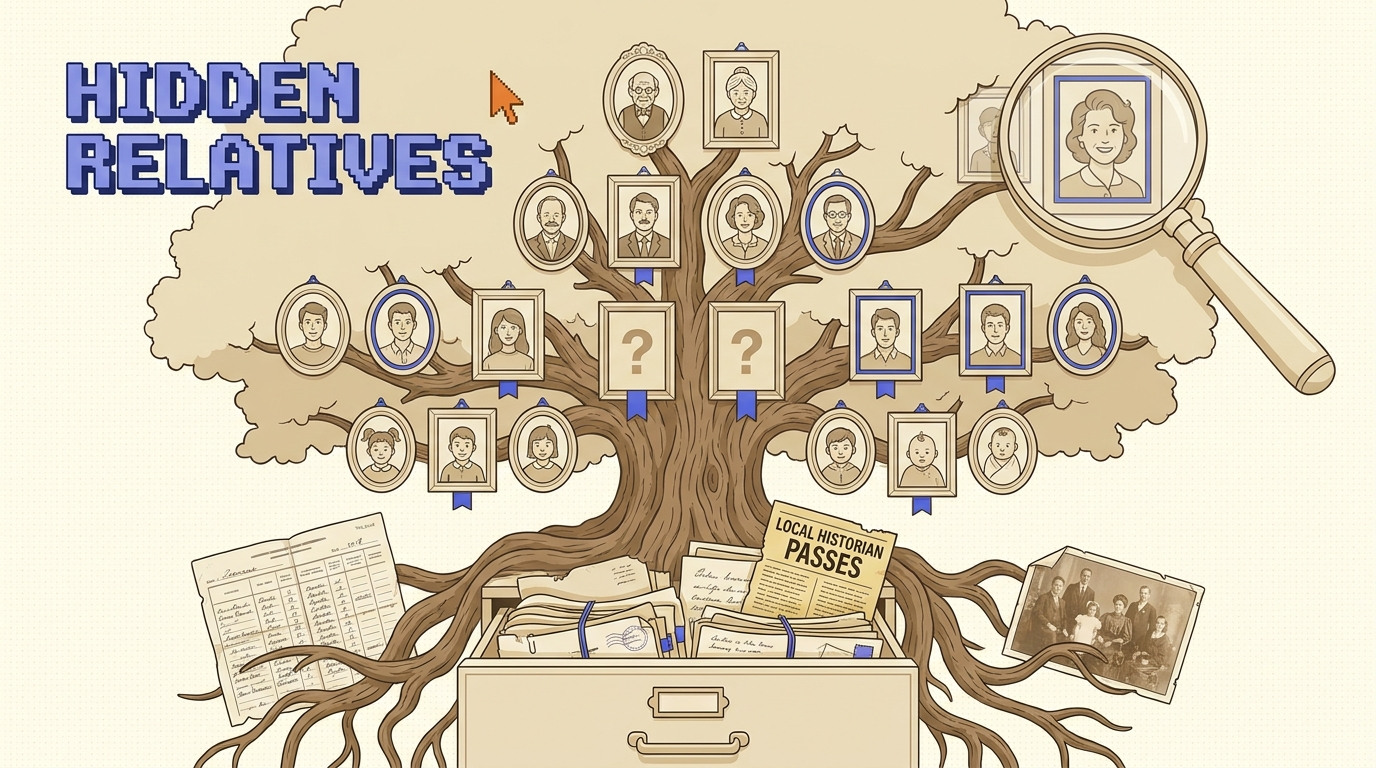
HIDDEN RELATIVES
Seven prompts that turn Claude into your family detective. Sweep the obituaries, read the census, cluster your DNA matches, and walk away with a sourced family tree and a list of living cousins nobody told you about.
> boot opusjake_os
> resource: hidden-relatives
> version: v1.0 · 2026-07-25
> status: ready_
Somewhere out there is a cousin holding the only photo of your great-grandmother. There is also a reason nobody talks about the uncle who left in 1962. The records that explain both are public, indexed, and mostly free. Almost nobody reads them, because reading them used to take years.
These seven prompts make Claude read them. Run them in order, in one chat.
THE INVENTORY
Every tree starts with what the family already thinks it knows. Get it out of your head and into a table before you touch a single record, because you cannot spot a contradiction against nothing.
Prompt 1 — the brain dump
I want to build my family tree and find relatives I do not
know about. Interview me for everything I actually know.

One question at a time. Start with my parents and work back:
full names, maiden names, birth and death years (guesses are
fine, label them as guesses), towns, religion, occupations,
and the family stories nobody has ever verified.

When I run dry, give me a table: one row per person, with a
confidence column (documented / family story / guess). Then
list the five biggest holes in what I told you, ranked by how
much filling each one would open up.
The confidence column is the point. A family story is a lead, not a fact, and half of yours will turn out to be about a different relative than you think.
Prompt 2 — the one conversation
My oldest living relative is [NAME], [AGE], my [RELATION]. I
get one good conversation. Build me the interview.

Twenty questions, ordered so the easy memories come first and
the sensitive ones (deaths, feuds, the person nobody mentions)
come after they have warmed up. Phrase every question to
surface names, places, and dates, not just feelings. Add the
follow-up I should ask any time they mention a name I have
not heard before.

Keep it printable on one page. I will record the call and
paste you the transcript to mine for the tree.
Records wait forever. This source does not. Every family has one person who remembers the town, the boat, and the feud, and nothing in any archive knows what they know.
THE PAPER TRAIL
The records are already digitized and indexed. FamilySearch is free, Find a Grave is free, the census through 1950 is free. Claude with web search reads in minutes what used to take a road trip.
Prompt 3 — the records sweep
Research this ancestor: [FULL NAME], born around [YEAR] in
[PLACE], died [PLACE AND YEAR IF KNOWN]. Use web search.

Work the free layers first: FamilySearch, Find a Grave,
BillionGraves, the 1950-and-earlier US census, WWI and WWII
draft cards, ship manifests, naturalization records, state
death indexes, and Chronicling America newspapers. Try
spelling variants; the name survived at least one tired clerk.

For every hit give me the claim, the source, the link, and
whether it is a primary record or someone's unsourced tree.
Never merge two people with the same name unless a date or
place ties them together. Close with the paid records worth
buying and exactly what each one would prove.
The same-name rule is the whole discipline. Merging two John Sullivans born four years apart is how a tree quietly becomes fiction, and it is the single most common error in every online database.
Prompt 4 — the obituary method
Obituaries are the cheat code, because they name their survivors. Every "survived by her sister Ruth of Akron" is a branch of your tree telling you it exists.
Search digitized newspapers and obituary sites for anyone
named [SURNAME] (and variants) who died in [COUNTY OR CITY]
between [YEAR] and [YEAR].

For each obituary you find, list the deceased, every surviving
relative exactly as written, and the stated relationships.

Then cross-reference against my tree. Flag every survivor who
does not appear in it, with their name, probable relationship
to me, last known town, and the obituary that proves the link.
That list is my hidden relatives.
This is the prompt that finds living people. The census stops in 1950, but obituaries run right up to last week.
THE DNA PASS
If you have tested with AncestryDNA or 23andMe, your match list is the richest source you own, and you have probably never read past page one. Skip this page if you have not tested.
Prompt 5 — cluster the strangers
Here is my DNA match list from [ANCESTRY / 23ANDME]: for each
match, their name, shared cM, and their listed tree or
surnames. [PASTE]

Run the Leeds method on my 90 to 400 cM matches: cluster them
into four groups using shared matches, one group per
grandparent line. Show the clusters as a table and label which
grandparent each group most likely belongs to, based on
surnames.

Then flag the anomalies: strong matches that fit no cluster,
and clusters that share zero surnames with my tree. For each
one, say what it could mean and name the single record search
that would test it.
The clusters tell you which grandparent a mystery cousin comes through before you exchange a single message. The anomalies tell you where the official story and the biological one disagree.
THE TREE
Research that lives in a chat scroll is research you will lose. Turn it into two artifacts: one you can look at, one every genealogy site can import.
Prompt 6 — build the artifact
Take everything in this chat and build two things.

One, an interactive family tree artifact. One card per person:
name, years, place, and a confidence color (documented /
probable / unverified). Me at the base, generations stacked
above, unknown ancestors shown as empty slots so I can see
the shape of what is missing.

Two, a GEDCOM file of the same tree so I can import it into
FamilySearch or Ancestry, with a note on every unverified
fact naming the record that would confirm it.

Then rank the ten thinnest branches by which single record
would grow each one the most.
GEDCOM is the universal format every genealogy platform reads. Export it, keep a copy, and your tree never belongs to one company's database.
THE STANDING WATCH
Archives add records every week. Obituaries publish every day. You should not be the one checking.
Prompt 7 — the standing search
Save everything we have built (the tree, the surname variants,
the counties, the open questions) as a skill called
family-tree, so I never have to re-explain it.

Then set up a scheduled task for Sunday mornings: search new
obituaries, newly digitized records, and fresh Find a Grave
entries matching my surnames and counties. Compare against
the tree. Email me only when something actually connects: who
it is, how they link, and the source.
And when a record hides behind a login (FamilySearch keeps its best scans for account holders, and the account is free), turn on Cowork so Claude gets its own browser. Sign in once yourself, hand it the collection, and let it page through the microfilm while you do something else.
BEFORE YOU RUN IT
- Records beat trees. Half the public trees online copied the same wrong grandfather from each other. When Claude cites somebody's tree, ask for the record underneath it. No record, no merge.
- The census has a clock. US census records go public 72 years after they are taken, which is why 1950 is the newest one you can read. Everyone later, you reach through obituaries, directories, and the living.
- Publish the dead, protect the living. Keep living relatives' birthdates, addresses, and maiden names out of any public tree. Those three fields are also security questions.
- Decide what you want to know before you look. A strong match that fits no cluster is information. Sometimes it means an adoption, a quiet remarriage, or an affair nobody wrote down. DNA hands out answers, not confirmations.
- First contact is a postcard, not a subpoena. Three sentences, one shared ancestor, one question: did I get this right? No asks. Let them set the pace. Remember that you might be their surprise.
Prompt 1 costs you twenty minutes tonight. Prompt 2 is the one with a deadline. Book the call with your oldest relative this week, because the archives will still be there next year and they might not.
// GET THE NEXT DROP
New resources go out to the list as they ship. One email, unsubscribe whenever.