How to Reduce AI Hallucinations (7 Fixes That Actually Work)
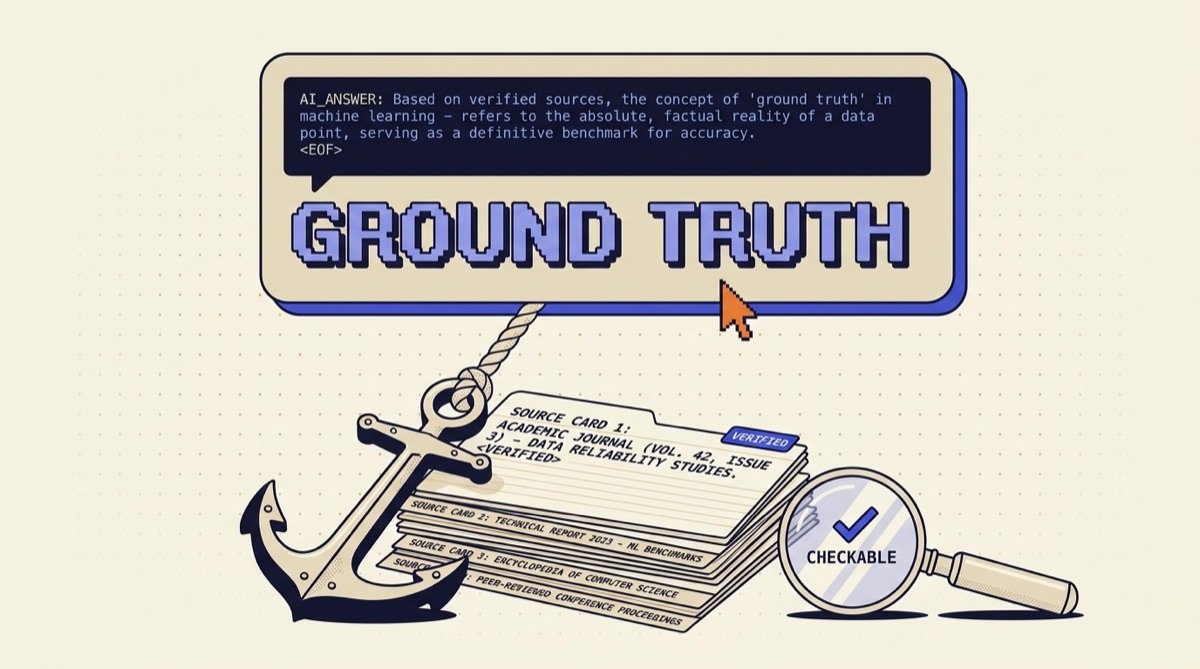
To reduce AI hallucinations, do three things: ground the model in real source material instead of its memory, give it explicit permission to say "I don't know," and verify every factual claim before you act on it. Most hallucinations are not a model defect. They are a model answering a question it had no facts for, because sounding right is what it was trained to do. Here are seven fixes that move the number.
TL;DR
- A hallucination is a confident, fluent answer with no grounding behind it. The model is guessing, and guessing is its default when facts are missing.
- The biggest single lever is retrieval: feed the model the real documents and tell it to answer only from them.
- Give the model an exit. A model allowed to say "I don't know" invents far less than one forced to always produce an answer.
- Demand citations. A claim you cannot trace to a source is a claim you cannot trust.
- Verify before you ship. For anything high-stakes, keep a check between the model's output and the action it triggers.
Why models hallucinate in the first place
A language model predicts the next likely token given everything before it. It is a fluency engine, not a truth engine. When you ask it something it has real training coverage for, the likely token and the true token usually match. When you ask about your internal docs, last week's news, or a specific case number, there is no reliable signal in its weights, so it produces the next plausible token anyway. The result reads exactly as confident as a correct answer, because confidence is a property of the writing, not the facts.
That reframe matters because it tells you where the fix lives. You are not trying to make the model smarter. You are trying to make sure that when it answers, the true answer is also the plausible one. Every fix below does that in a different way.
Fix 1: Ground the model in real sources (RAG)
The highest-leverage move is to stop asking the model to recall and start asking it to read. Retrieval-augmented generation means you fetch the relevant documents first, paste them into the prompt, and instruct the model to answer only from what you gave it.
The instruction is as important as the retrieval. "Answer using only the documents below. If they do not contain the answer, say so" turns the source list into a fence. Without that line, the model treats your documents as suggestions and still reaches for memory when they run thin. RAG is not a silver bullet, the model can still misread a passage or blend two of them, but it moves the base rate more than anything else on this list.
Fix 2: Give the model an exit
Models invent because we back them into a corner. A prompt that demands an answer to every question, with no acceptable way out, teaches the model that "I don't know" is a wrong answer. So it fabricates rather than admit the gap.
Fix it in one line: "If you are not confident or the sources do not cover this, say 'I don't have enough information to answer that' instead of guessing." You are not making the model dumber. You are changing which behavior it treats as failure. This single instruction catches a surprising share of hallucinations, because a large chunk of them happen at the edge of the model's knowledge, exactly where an exit ramp helps most.
Fix 3: Demand a citation for every claim
A claim you cannot trace is a claim you cannot trust. Require the model to attach a source to each factual statement: a document name, a line number, a URL, a quoted snippet. Two things happen. First, you can check the work in seconds instead of re-researching it. Second, the requirement itself suppresses invention, because a model asked to cite has to have something to point at, and "I made this up" is not a citation it will write.
This is also how you detect hallucinations at scale. Build the citation check into your pipeline: for each claim, confirm the cited source actually says it. When the source does not back the claim, you have caught a hallucination before it reached a user. This is the same drift-catching instinct behind the Canary Method, a one-line trick that warns you the moment an AI session starts to wander off the facts.
Fix 4: Constrain the question, not just the answer
Broad questions invite broad guessing. "Summarize everything about this account" gives the model room to fill gaps with invention. "List only the payments over $500 from the transactions below, with dates" gives it a narrow, checkable task where a wrong answer is obvious. The tighter the question, the less surface area a hallucination has to hide in.
The same applies to output shape. Asking for structured output, a table or a JSON object with named fields, forces the model to either fill a field from the source or leave it empty. A blank field is honest. A paragraph is where fabrication blends in. If you want the mechanics of this, our guide on getting reliable structured output from an LLM walks through it.
Fix 5: Verify with a second pass
For anything that matters, do not trust the first answer, check it. The cheapest version is a second model call that plays skeptic: "Here is a claim and its source. Does the source actually support the claim? Answer yes or no and quote the line." A model is a much better critic than author because judging one claim against one source is a narrow, groundable task. Two independent passes that disagree is your signal to stop and look.
Verification is where you decide how much risk you can hold. A blog draft can ship on one pass. A medical dose, a legal citation, or a wire transfer needs a human in the loop, every time, no exceptions.
Fix 6: Feed it fresh facts, not stale memory
A model's training has a cutoff. Ask it about anything after that date, or anything that changed since, and it will answer from an outdated snapshot with full confidence. This is a hallucination you can prevent entirely by supplying the current fact in the prompt: today's date, the live price, the latest status. Connect the model to a search tool or a database so it pulls current data instead of reciting a frozen one. If the answer depends on something that changes, never let the model answer from memory.
Fix 7: Lower the temperature for factual work
Temperature controls how much randomness the model injects when picking each token. High temperature is good for brainstorming and bad for facts, because it nudges the model toward less likely, more inventive tokens. For anything factual, turn it down. This is the smallest lever on the list, a model can still hallucinate confidently at temperature zero, but when the task is extraction or lookup, there is no upside to creativity. Set it low and take the determinism.
The bottom line
Hallucinations are not a mystery and not a model you are stuck with. They are what happens when a fluency engine answers a question it had no facts for. Ground it in real sources, give it permission to say "I don't know," make it cite every claim, and verify before you act. Do those four and the rate falls off a cliff. You will not hit zero, so keep a check between the model and anything that matters. That is the whole game: manage the risk, do not pretend it is gone.
If you want more field-tested ways to make AI actually reliable instead of just impressive, join the OpusJake newsletter. One practical build per week, no fluff.
Why do AI models hallucinate?
A language model predicts the next likely token, not the true one. When it has no grounding for a fact, it still produces a fluent, confident answer because fluency is what it optimizes for. Hallucinations are not bugs in the usual sense, they are the model doing exactly what it was trained to do without the facts it needs. Give it the source material and a way to say 'I don't know,' and the rate drops sharply.
Can you eliminate AI hallucinations completely?
No. You can drive the rate down a long way with grounding, constraints, and verification, but no current model hits zero. Treat it as a risk you manage, not a bug you close. For anything high-stakes, keep a human or an automated check between the model's output and the action it triggers.
Does retrieval-augmented generation (RAG) stop hallucinations?
RAG cuts hallucinations a lot because the model answers from retrieved documents instead of memory, but it does not stop them. The model can still misread a passage, blend two sources, or answer confidently when retrieval returned nothing useful. Pair RAG with an instruction to cite the source and to refuse when the documents do not cover the question.
Does a lower temperature reduce hallucinations?
Lower temperature makes the output more deterministic and slightly less likely to invent, but it is a minor lever. A model can hallucinate confidently at temperature zero. Grounding it in real sources and letting it say 'I don't know' move the number far more than any sampling setting.
How do I know if my AI is hallucinating?
Ask it to cite its source for every factual claim, then check the citations against the real documents. If a claim has no source, or the source does not say what the model claims, that is a hallucination. Building this citation check into your pipeline turns hallucination detection from a spot check into a habit.
OpusJake is Jake Schincariol's operating system for building with AI: agents, workflows, prompts, and the free resources behind them. Get the next move every week.