AI Automation in 2026: What Actually Works and What Burns Money
AI automation is using a language model to run the parts of a business process that used to need a person to read, decide, write, or route. In 2026 the technology is no longer the constraint. Picking the right process is. Only about one in five US businesses uses AI at all, and Gartner expects more than 40 percent of agentic projects to be canceled by the end of 2027, almost never because the model was not smart enough.
TL;DR
- AI automation is worth building when a process is high volume, low variance, text-shaped, and reversible. All four, not three.
- The US Census Bureau put national business AI use at 19.8 percent as of May 2026, so this is still early, not late.
- Gartner expects over 40 percent of agentic AI projects to be canceled by end of 2027, on cost, unclear value, and weak controls.
- McKinsey found workflow redesign is the attribute most correlated with real EBIT impact, ahead of tooling.
- Do the arithmetic first. Minutes per run times runs per month times 0.7. Under four hours saved a month, do not build it.
What AI automation means now
Three layers get called the same thing, and conflating them is where budgets die.
Assistive is a person prompting a model and keeping the output. Real value, zero leverage, because it stops the moment nobody is typing.
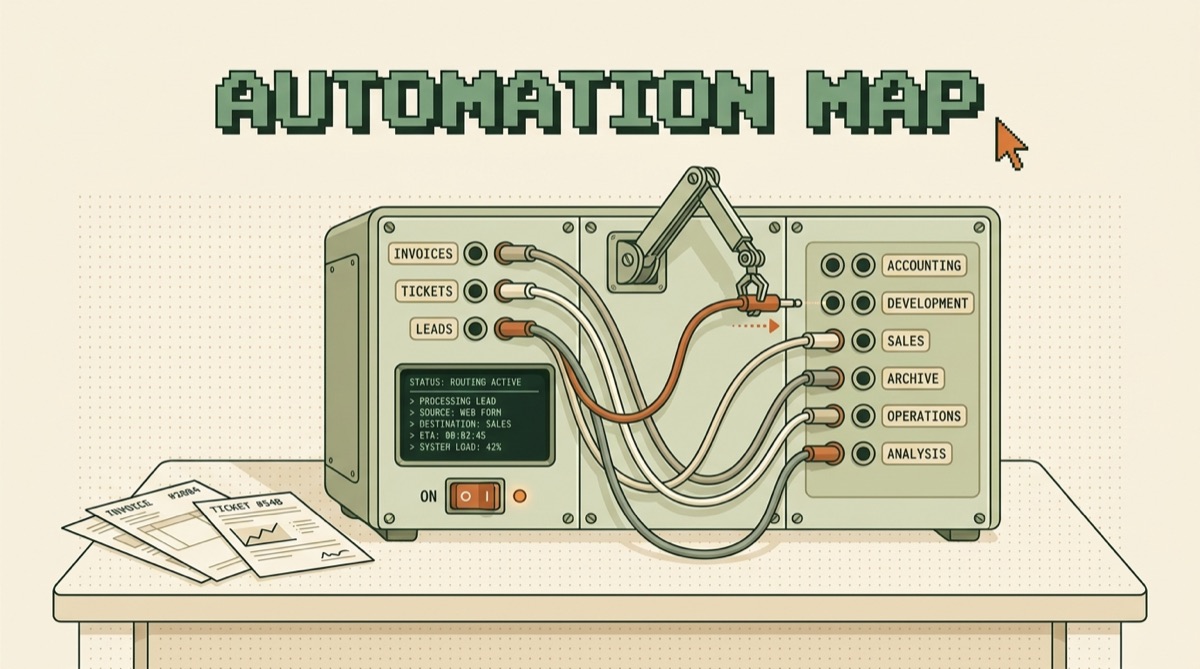
Workflow is code that calls a model at fixed steps inside a pipeline that runs whether or not anyone is watching. An invoice lands in an inbox, a model extracts eleven fields, code validates them against the purchase order, and a record is written. This is where most of the captured value sits in 2026, because it is the layer you can test, price per run, and repair when it drifts.
Agentic is the model choosing its own tools and order to reach a goal. Genuinely useful when the path depends on what the model finds along the way, and expensive when it does not. I wrote up how to tell those apart in AI workflow vs AI agent.
Most teams asking about AI automation want the second layer and buy the third.
The failure numbers, and what they actually say
The headline statistics look damning until you read the stated causes.
Gartner's projection of over 40 percent of agentic AI projects canceled by the end of 2027 lists escalating costs, unclear business value, and inadequate risk controls. Not accuracy. Not capability. Three project management failures wearing a technical costume.
McKinsey's State of AI research approaches it from the other side. Across 25 organizational attributes tested, redesigning workflows had the biggest effect on whether a company saw EBIT impact from generative AI. Adding a model to a process that kept all of its old handoffs, approvals, and exception paths mostly produces a faster bottleneck.
The more useful number is the adoption one. The Census Bureau's biweekly survey put AI use among US businesses at 19.8 percent as of early May 2026, with firms of 250 or more employees at about 37 percent and small firms flat. Information sits near 39.7 percent and finance and insurance near 33.9 percent. Four out of five businesses are still not using this at all. If you run a real process well, you are early.
The four-filter test
Every candidate process gets four questions. Build only when it passes all four.
Volume. Does it happen at least a few hundred times a month? Frequency is what pays back a build. A monthly task is a bad first target no matter how annoying it is.
Variance. Do roughly 80 percent of runs look alike? Low variance means one path handles most cases and exceptions route to a person. High variance means you are writing a rules engine with extra steps.
Text-shaped. Are the inputs and outputs language or structured data? Reading a PDF is text-shaped. Rebuilding a client relationship is not.
Reversible. Can a wrong output be caught before it reaches a customer, a ledger, or a public channel? Reversible processes can run with light oversight. Irreversible ones need an approval gate, which is a real cost you should price in from day one.
Do the arithmetic before you build
This takes ten minutes and kills most bad ideas.
Take minutes per run, multiply by runs per month, and you have the current cost in hours. Multiply that by 0.7, because automation realistically removes 60 to 80 percent of the time rather than all of it. Review, exceptions, and maintenance never reach zero, and anyone promising otherwise has not run one of these for six months.
Invoice intake at a 40 person company: 6 minutes per invoice, 420 invoices a month, so 42 hours. Times 0.7 is roughly 29 hours a month recovered. That is most of a person's week, and it pays for a two week build in the first quarter.
Now the one people skip. A quarterly board deck takes 5 hours and runs 4 times a year, so 20 hours annually. Times 0.7 is 14 hours a year, or about 1.2 hours a month. That will not survive its own maintenance. Leave it alone.
If the number lands under about four hours a month, the honest answer is do not build it. Pick a bigger target instead of arguing with the math.
Build the pipeline, not the chatbot
The shape that works is unglamorous. A trigger, a small number of model calls at fixed steps, validation in plain code between them, and a human gate on anything irreversible.
For that invoice pipeline: a webhook fires on a new email attachment, one model call extracts the eleven fields, code checks the total against the purchase order and the vendor against your approved list, anything that reconciles cleanly under a threshold posts automatically, and anything else lands in a review queue with the extracted fields pre-filled. Two model calls, deterministic validation, one gate.
Notice what is absent. No chat interface, no agent deciding what to do next, no conversation. The people whose time you just recovered never talk to it. Model output that has to be exactly right, like those eleven fields, should be structured and schema-validated rather than parsed out of prose.
The single highest leverage habit here is writing the loop rather than a longer prompt, which is the whole idea behind WRITE LOOPS NOT PROMPTS. If finance is your first target, CLAUDE FINANCE AGENTS walks through that specific build. If you are still assembling the tools underneath all of this, start with THE AI DAILY DRIVER STACK.
Measure three things, starting on day one
Most automation gets judged on vibes six months in, which is how good systems get killed and bad ones survive.
Hours recovered per month. Runs times minutes saved. The number you promised. Track it against the estimate you made before building, because that gap teaches you how to scope the next one.
Exception rate. The percentage of runs a human had to touch. It should fall over the first eight weeks as you fix the top three failure patterns. If it is flat at week eight, the process failed the variance filter and you missed it.
Cost per run. Model spend divided by runs. This one drifts upward quietly as prompts grow and context accumulates, and it is the number that turns into the surprise invoice Gartner keeps writing about.
Three numbers on one dashboard. If you cannot produce them, you do not know whether your AI automation is working, you just know it is running.
The bottom line
AI automation in 2026 is not a technology bet, it is a selection problem. The model will handle almost any text-shaped step you hand it. Whether that step is worth automating is a question about volume, variance, reversibility, and arithmetic you can do before writing a line of code.
Pick the boring, frequent, reversible process. Build a pipeline with validation between the steps and a gate on anything irreversible. Measure hours recovered, exception rate, and cost per run from the first week. Then do it again. Four out of five businesses have not started, and the ones that win will not be the ones with the best model, they will be the ones that picked the right ten processes.
Want the next build, every week? I send one practical AI system every Wednesday: the process, the prompts, and what broke. Join the newsletter, or grab THE MCP BIG THREE and wire your first pipeline to real tools this week.
What is AI automation?
AI automation is using a language model to run steps of a business process that previously required a person to read, judge, write, or route something. Traditional automation moves data between systems when the rules are fixed, so a Zapier trigger firing on a new row is automation but not AI automation. AI automation covers the steps that used to break a rules engine, like reading a supplier invoice that arrives in a different layout every month, deciding which of eleven categories a support ticket belongs in, or drafting a reply that references the customer's actual history. In 2026 it usually shows up in three layers. Assistive, where a person prompts a model and keeps the output. Workflow, where code calls a model at fixed steps inside a pipeline that runs without anyone watching. Agentic, where the model chooses its own tools and order to reach a goal. Most of the value being captured right now sits in the middle layer, because it is the one you can test, price, and repair.
Is AI automation actually worth it for a small business?
It is worth it when a specific process clears a volume threshold, and it is a waste when it does not. The arithmetic is simple enough to run in a spreadsheet before you build anything. Multiply the minutes a task takes by how many times it runs each month to get the current cost in hours. Automation realistically removes 60 to 80 percent of that time rather than 100 percent, because review, exceptions, and maintenance never go to zero. If the remaining saving is under about four hours a month, the build and upkeep will cost more than the process does, so leave it alone and pick a bigger target. The processes that clear the bar in a small business are almost always unglamorous and high frequency, like invoice intake, inbound lead qualification, recurring reporting, and support triage. The exciting ones people pitch first, usually customer-facing content or sales calls, tend to be low frequency and high variance, which is the worst possible combination to automate first.
Why do most AI automation projects fail?
Because teams buy a tool instead of redesigning a process. Gartner expects more than 40 percent of agentic AI projects to be canceled by the end of 2027, citing escalating costs, unclear business value, and inadequate risk controls, and none of those three causes is a model problem. McKinsey's State of AI research points at the same thing from the positive direction. Out of 25 organizational attributes tested, redesigning workflows had the single biggest effect on whether a company saw EBIT impact from generative AI. Dropping a model into a process that still has the same handoffs, the same approvals, and the same twelve exception paths mostly produces a faster version of the old bottleneck. The other common killer is scope. Teams pick the most visible process rather than the most repetitive one, so they end up automating something that runs eleven times a month with wild variance instead of something that runs four hundred times with almost none.
What processes should you automate with AI first?
Run every candidate through four filters and only build when it passes all four. Volume, meaning it happens at least a few hundred times a month, because that is what pays back the build. Low variance, meaning most runs look like each other, so 80 percent of cases follow one path. Text-shaped, meaning the inputs and outputs are language or structured data rather than a physical action or a relationship. And reversible, meaning a wrong output can be caught and undone before it reaches a customer or a ledger. A process that passes all four is usually boring, which is the point. Invoice and receipt intake, ticket classification and routing, meeting notes to CRM fields, weekly reporting, and lead enrichment all pass. Negotiating a contract fails on variance and reversibility. Writing your keynote fails on volume. If a candidate fails a filter, that is not a reason to try harder, it is a reason to pick a different candidate.
What is the difference between AI automation and an AI agent?
The difference is who decides the next step. In AI automation of the workflow kind, you decide. The steps and their order are written in code, and the model does the language work inside each step, so run one and run ten thousand take the same path. In an agent, the model decides. You give it a goal, tools, and a stopping condition, and it chooses which tool to call and when it is finished, so two similar inputs can take different routes. That distinction drives cost and testability. A fixed workflow makes a known number of model calls and can be unit tested step by step, while an agent re-sends its growing context on every step and commonly costs several times more per run. For most business processes the fixed workflow is the correct build, with an agent reserved for the one step where the path genuinely depends on what the model finds.
OpusJake is Jake Schincariol's operating system for building with AI: agents, workflows, prompts, and the free resources behind them. Get the next move every week.