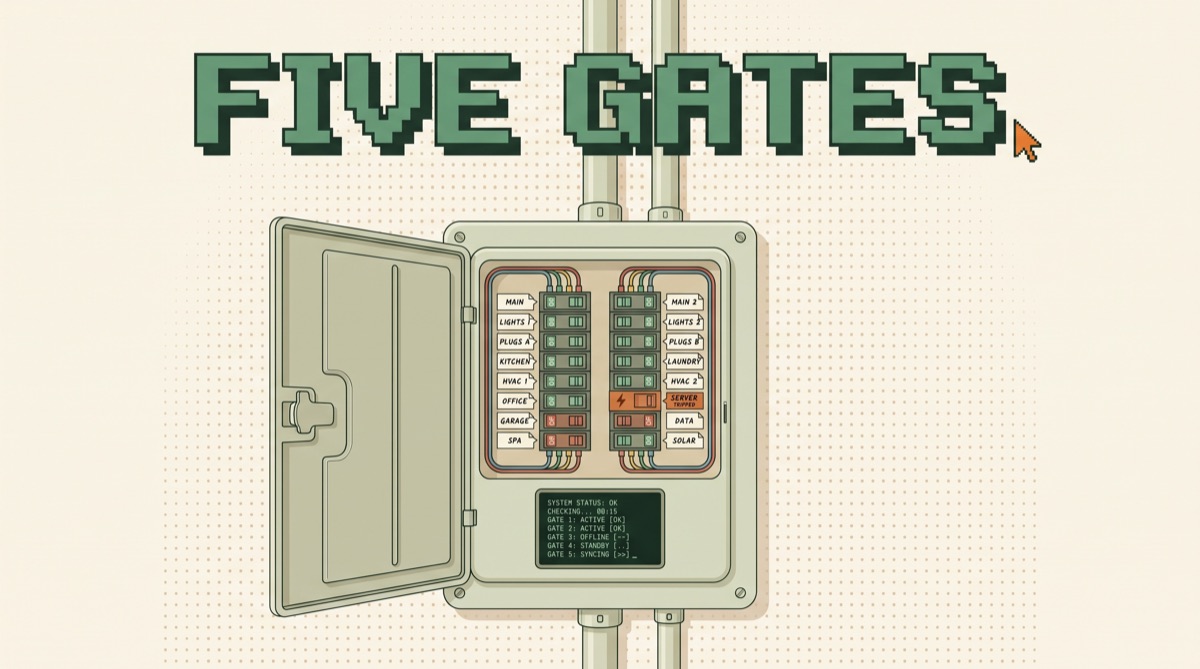
Responsible AI is five gates in your code, not a document in your drive. An input gate that filters what reaches the model, grounding that ties answers to a source, an output check that catches known failures, an action scope that limits what the system can touch, and a ledger you can replay after an incident. A small team can ship all five in a sprint. Here are the current numbers, the deadlines that actually bind in 2026, and what each gate looks like in practice.
01TL;DR
- Stanford HAI's 2026 AI Index reports the AI Incident Database logged 362 incidents in 2025, up from 233 in 2024, a 55 percent jump.
- The same report has the share of organizations rating their AI incident response as excellent falling from 28 percent in 2024 to 18 percent in 2025. Policy is outrunning capability.
- The Foundation Model Transparency Index average fell from 58 in 2024 to 40 in 2025 after rising from 37 the year before. Disclosure went backwards.
- Regulation (EU) 2026/1744, published 24 July 2026, deferred Annex III high-risk duties to 2 December 2027, but Article 50 transparency still took effect 2 August 2026.
- Hallucination rates across 26 leading models range from 22 percent to 94 percent on the AI Index accuracy benchmark. There is no model you can skip the output gate for.
02The failure is execution, not intent
Almost every team I work with already has an AI policy. Very few can tell me which line of code enforces it. That gap is now measurable. The AI Index found that the share of surveyed organizations with no responsible AI policy dropped from 24 percent to 11 percent, so the documents got written. Over the same window, self-rated incident response got worse, with excellent falling from 28 to 18 percent and good falling from 39 to 24 percent.
Documents do not catch anything. Gates do. And the obstacles teams report are practical rather than philosophical: 59 percent named knowledge gaps, 48 percent named budget, and 41 percent named regulatory uncertainty. None of those are solved by another framework. They are solved by picking five specific controls and shipping them.
03Gate one and two: what the model reads
The input gate is the cheapest control and the one most often missing. OWASP's Top 10 for LLM Applications has kept prompt injection at LLM01 across both editions, because any text your system retrieves is text an attacker can write. A support ticket, a PDF, a web page, a calendar invite. If a retrieved document can reach the model, treat it as untrusted user input, not as context.
Practically: strip or escape retrieved content before it enters the prompt, separate instructions from data at the message level, and never let retrieved text carry tool-calling authority. I wrote the full pattern in how to prevent prompt injection, and it has not changed much because the underlying problem is architectural rather than a filter you can buy.
Grounding is the second gate and it is what keeps the accuracy problem bounded. The AI Index accuracy benchmark found hallucination rates across 26 top models spanning 22 percent to 94 percent, with GPT-4o's accuracy on that benchmark falling from 98.2 percent to 64.4 percent and DeepSeek R1 falling from over 90 percent to 14.4 percent. Those swings are not a reason to pick a different model. They are a reason to make every claim carry a citation the reader can click, so a wrong answer is visibly wrong instead of quietly wrong.
04Gate three: the eval set is the control
An output check that is a vibe is not a control. It needs a fixed set of inputs with known-good outputs, run on every change, with a score you can compare across runs.
Sixty cases is enough to start. At three minutes each to write from real production inputs, that is three hours of work, once. Run it before every prompt change and every model swap. The LLM as a judge pattern handles the grading for anything where exact string matching does not apply, with the caveat that the judge itself needs a calibration set or you are just moving the trust problem sideways.
The point is not perfection. It is that the day a model provider ships an update, you find out in twelve minutes instead of from a customer.
05Gate four: scope the agent, not the model
This is the one that separates a chat feature from a liability. OWASP ranks excessive agency at LLM06 in the 2025 edition, and the definition is exactly right: a system granted more permission, more functionality, or more autonomy than the task requires.
A model that answers wrong wastes a reader's time. An agent that acts wrong sends the email, updates the record, or moves the money. The fix is boring and it works. Give the agent its own credential rather than a service account. Grant the narrowest scope the task needs, read-only wherever read-only will do. Put a hard ceiling on spend and call volume. Route anything irreversible through an approval step, which is the whole argument in human in the loop AI agent. And log the tool call, not just the response.
Finance is the clearest example of where the line sits, because the categories are already legible. Reconciliation and variance explanation are safe to automate. Anything that moves money gets a human. That split is the whole structure of Claude Finance Agents, and it generalizes: automate the reading, gate the writing.
06Gate five: the ledger, and why it is not observability
Store the input, the retrieved context, every tool call with its arguments, and the final output, keyed to a request ID. Not a metrics dashboard. The actual payloads, for long enough to investigate a complaint.
This is different from AI agent observability, which tells you the system is healthy. A ledger tells you what happened in one specific case eleven days ago when a customer says the system told them something wrong. Without it, the honest answer is that you do not know, and that answer is expensive in a way that has nothing to do with technology.
Pair it with a canary. A small scheduled run against known inputs, alerting on drift, catches the silent degradation that no dashboard surfaces because nothing errored. That is the entire method in The Canary Method, and it is the cheapest insurance on this list.
07The paperwork, ranked by whether it binds
Regulatory uncertainty was the third most cited obstacle in the AI Index survey at 41 percent, and a lot of that uncertainty is people tracking deadlines that moved.
Here is where it stands. The Digital Omnibus on AI, Regulation (EU) 2026/1744, was published in the Official Journal on 24 July 2026 and entered into force on 27 July, six days before the AI Act's original high-risk deadline. It pushed Annex III high-risk obligations for stand-alone systems out to 2 December 2027 and Annex I embedded high-risk to 2 August 2028. What stayed: Article 50 transparency duties applied from 2 August 2026, general-purpose AI provider obligations have applied since August 2025, and the prohibited-practices ban has been live since February 2025. If your product talks to an EU user, disclosure is a today problem, not a 2027 problem.
For frameworks, NIST's AI Risk Management Framework is the one to build against. Version 1.0 landed 26 January 2023, organized around four functions: govern, map, measure, manage. The Generative AI Profile, NIST-AI-600-1, followed on 26 July 2024, and NIST released a concept note for a critical-infrastructure profile on 7 April 2026. It is free and it maps cleanly onto the five gates above. ISO/IEC 42001 is the certifiable one, cited by 36 percent of AI Index respondents against 33 percent for NIST, and it matters when a procurement team needs a certificate rather than a description.
Build against NIST. Certify against ISO only when a customer asks and is paying for the answer.
08The bottom line
Responsible AI in 2026 is not a philosophy problem. Incidents rose to 362 in 2025, model transparency scored worse than the year before, and self-rated incident response got weaker while policy coverage got broader. That combination has one reading: teams wrote the document and skipped the gates.
The five gates fit in a sprint. An input filter, grounded citations, a sixty-case eval set, a scoped credential with a spend ceiling and an approval step, and a request-keyed ledger with a canary on top. None of it requires a governance function. All of it survives an audit better than a policy PDF does, because it produces evidence instead of intent.
Ship the action scope first. It is a config change today and an incident report later. Start with The Canary Method for the drift alerting, then join the newsletter for the builds I run each week, including the eval harnesses and gate patterns that end up in production.
Frequently asked
What is responsible AI?
Responsible AI is the set of controls that decide what an AI system is allowed to read, say, and do, plus the record that lets you reconstruct any decision after the fact. Most people meet it as a values statement, which is why it has a reputation for being decorative. The working definition is narrower and more useful: an input gate that filters what reaches the model, grounding that forces answers back to a source, an output check that catches the failures you already know about, an action scope that limits what the system can touch, and a ledger that survives the incident. Everything else is documentation of those five things. If a team cannot name where each one lives in the repo, it does not have responsible AI, it has an intention.
Do small companies need responsible AI, or is it only for enterprises?
The controls scale down better than the paperwork does. A two-person team will never staff an AI ethics board, and does not need one, but it absolutely needs a scoped credential, an eval set, and a log it can replay. Stanford HAI's 2026 AI Index found the share of surveyed organizations with no responsible AI policy at all fell from 24 percent to 11 percent, so having something written down is now the norm rather than a differentiator. The gap has moved to execution. The same report shows the share of organizations rating their AI incident response as excellent dropping from 28 percent in 2024 to 18 percent in 2025, which is what happens when policy grows faster than the controls underneath it.
What are the main risks responsible AI is supposed to catch?
Four categories cover most of the real damage. Wrong output that gets treated as right, which is the hallucination problem and the one that scales with how much you trust the system. Leaked context, where prompts, retrieved documents, or system instructions escape to the wrong reader. Excessive agency, where a system that can call tools takes a consequential action nobody sanctioned. And silent drift, where a pipeline that worked in March quietly degrades by August and nothing tells you. OWASP's Top 10 for LLM Applications ranks prompt injection first and excessive agency sixth, which reflects where the incidents actually cluster once a model gets tools instead of just a chat box.
Does the EU AI Act apply to my product in 2026?
Partly, and the answer changed in late July 2026. Regulation (EU) 2026/1744, the Digital Omnibus on AI, was published in the Official Journal on 24 July 2026 and entered into force on 27 July, six days before the AI Act's original high-risk deadline. It deferred the Annex III high-risk obligations for stand-alone systems, covering hiring, credit scoring, and education, to 2 December 2027, and Annex I high-risk embedded in already-regulated products to 2 August 2028. What did not move: the Article 50 transparency duties took effect on 2 August 2026, the general-purpose AI provider obligations have applied since August 2025, and the prohibited-practices regime has been enforceable since February 2025. If you ship a chat interface into the EU, disclosure applies to you now.
What is the difference between the NIST AI RMF and ISO 42001?
NIST's AI Risk Management Framework is a voluntary US framework organized around four functions: govern, map, measure, and manage. It was released as version 1.0 on 26 January 2023, with a Generative AI Profile, NIST-AI-600-1, following on 26 July 2024 that names the risks specific to generative systems. It is free, it is not certifiable, and it reads like an engineering checklist. ISO/IEC 42001 is an auditable management-system standard, which means a third party can certify you against it and a customer procurement team can ask for the certificate. Stanford HAI's 2026 AI Index found 36 percent of surveyed organizations cited ISO 42001 as shaping their responsible AI approach against 33 percent for the NIST framework. Use NIST to build. Use ISO when someone needs proof.