RAG vs Fine-Tuning: How to Customize Your AI Without Wasting Money
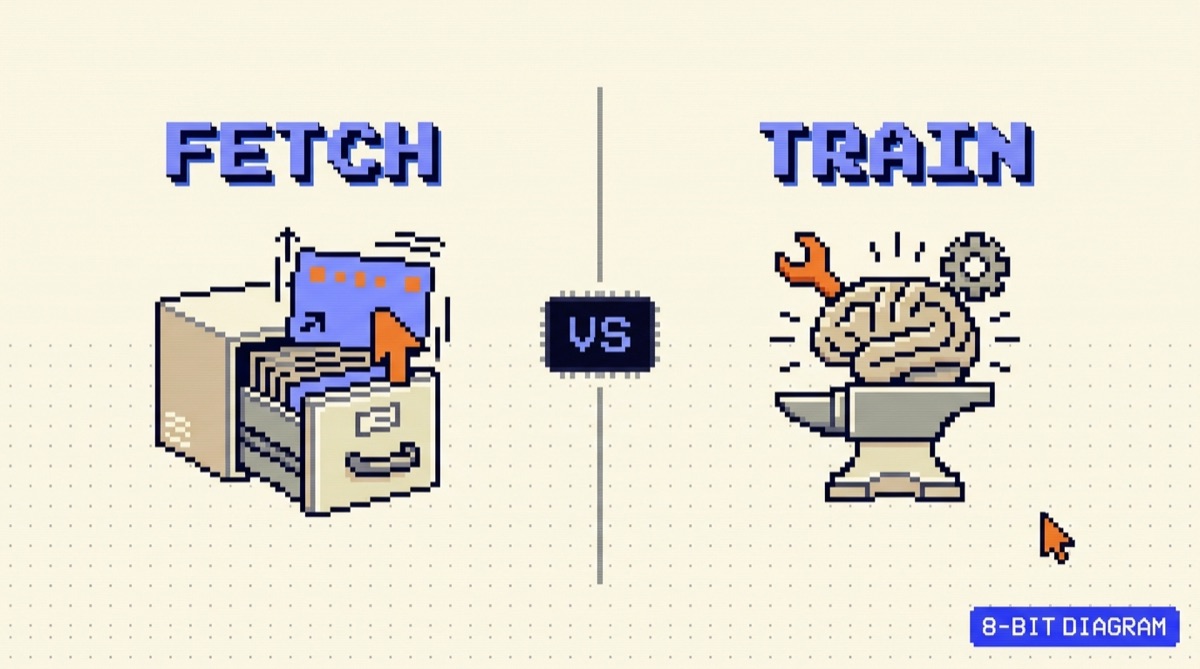
RAG vs fine-tuning comes down to one question: does your AI need fresh knowledge or a new skill? RAG (retrieval-augmented generation) fetches the right facts at the moment of a question and feeds them to the model, so answers stay current and specific. Fine-tuning bakes patterns into the model's weights through training, so it learns a tone, format, or task. Most builders need RAG first, fine-tuning rarely, and sometimes both.
TL;DR
- RAG fetches knowledge at runtime. Fine-tuning teaches behavior in advance. Different jobs, not rivals.
- Reach for RAG when the answer depends on facts that change or are private to you: docs, tickets, a catalog, your own notes.
- Reach for fine-tuning when you need a consistent format, tone, or a narrow task the base model keeps fumbling, and the rules are stable.
- RAG is cheaper to start, easy to update, and shows its sources. Fine-tuning costs more, is opaque, and goes stale.
- The honest default: start with prompting, add RAG, fine-tune last and only if a measured gap remains.
What RAG actually does
RAG stands for retrieval-augmented generation, and the name is the whole idea backward. Before the model generates an answer, you retrieve the relevant facts and augment the prompt with them. The model never has to know your data ahead of time. It gets handed the right slice at question time.
The flow is simple. You take your documents, split them into chunks, and store them in a way you can search by meaning, not just by keyword. When a question comes in, you search that store, pull back the handful of chunks that match, and paste them into the prompt with an instruction like "answer using only the context below." The model reads those facts and writes a grounded reply, often with citations pointing back to the source.
The payoff is that knowledge lives outside the model. Your AI can answer questions about a doc written this morning, a private database it has never seen, or a policy that changed yesterday. You update an answer by editing a file, not by retraining anything. And because the model is quoting retrieved text, you can show its sources, which is what makes the answer checkable instead of a guess.
What fine-tuning actually does
Fine-tuning takes an existing model and keeps training it on your own examples until the behavior you want is baked into its weights. You are not handing it facts at question time. You are reshaping how it responds before any question arrives.
The flow is heavier. You assemble a dataset of input-output pairs that demonstrate the behavior you want, hundreds to thousands of them, then run a training job that nudges the model toward those patterns. The result is a new model you host and call like the original, except now it has internalized the style, structure, or task you trained it on.
The payoff is consistency and compression. A fine-tuned model can hit a rigid output format every time, adopt a specific voice, or handle a narrow task more reliably than the base model with a long prompt. It can also let you drop pages of instructions, since the behavior now lives in the weights instead of the prompt. The catch is that what it learned is frozen. Teach it last quarter's pricing and it will repeat last quarter's pricing forever, confidently, until you retrain.
RAG vs fine-tuning: the side-by-side
The cleanest way to hold these apart is knowledge versus behavior. RAG changes what the model knows in the moment. Fine-tuning changes how the model acts in general.
A few practical contrasts fall out of that split. Updating RAG means editing a document; updating a fine-tune means retraining. RAG can cite where an answer came from; a fine-tune cannot tell you why it said what it said. RAG starts with no training run and a small bill per question; fine-tuning starts with a labeled dataset and a training job. None of this makes one better. It makes them suited to different failures.
When to choose RAG
Default to RAG when the problem is that the model does not know something it needs to know. The tells are easy to spot.
- The facts change. Prices, policies, inventory, status, anything dated. RAG reads the current version every time.
- The data is yours and private. Internal docs, support tickets, a customer database, your own writing. The model was never trained on it and should not be.
- You need receipts. Support, research, anything where a wrong answer is expensive. Citations let the reader verify instead of trust.
- The corpus is large or growing. You cannot stuff a thousand documents into a prompt, but you can retrieve the five that matter.
This is the same instinct as feeding an agent the right context instead of hoping it already has it. If you are assembling the tools to do that well, the AI Daily Driver Stack is the short list I actually run, and most of it plays nicely with a retrieval setup.
When to choose fine-tuning
Reach for fine-tuning when the problem is not missing knowledge but inconsistent behavior. The model knows enough; it just will not do the thing the same way every time, or your prompt to make it behave has grown into a wall of text.
Good candidates look like this. You need output in a strict schema on every call and the model drifts. You want a specific voice that a prompt only approximates. You have a narrow, repeating task, like classifying tickets into your exact categories, where a handful of examples in the prompt is not enough and you have real labeled data. Or your instructions have gotten so long that latency and cost are hurting, and you would rather move the behavior into the weights.
The condition under all of these is that the rules are stable. Fine-tuning is worth it when the behavior you are teaching will hold for a while. If it changes monthly, you will spend your life retraining, and that is exactly the work RAG was built to avoid.
Why you often want both
The split between knowledge and behavior is also why the two pair so well. Fine-tune the model to lock in how it should respond, then use RAG to feed it what to respond about. The fine-tune handles voice, format, and how to call your tools. Retrieval handles the current facts. You get a consistent assistant that is also up to date, which neither approach delivers alone.
A support bot is the clean example. Fine-tune it on past conversations so it answers in your brand voice and always returns the right structure. Then wire RAG into your live help center so every reply quotes the current article, not whatever was true when you trained. Behavior stays fixed, knowledge stays fresh. That is the combination most production systems land on once they mature.
How to decide in practice
You do not need to agonize over this. Walk the ladder in order and stop at the first rung that solves your problem.
- Prompt first. Before anything fancy, write a sharper prompt with a few good examples. A surprising amount of "we need fine-tuning" is really "we needed a better prompt." This is the cheapest fix and you should exhaust it first.
- Add RAG when the gap is knowledge. If the model is wrong because it lacks your facts, or its facts are stale, retrieval is the answer. This handles the large majority of real builder problems.
- Fine-tune when the gap is behavior. If the knowledge is right but the format, tone, or task reliability is wrong, and the rules are stable, fine-tune. Bring a measured gap, not a hunch.
- Combine only when you have proven you need both. Reach for the pair once a single approach has a clear, named shortcoming you can point to.
The mistake I see most is jumping straight to fine-tuning because it sounds like the serious option. It is the expensive option, and it is the wrong tool for stale or private knowledge, which is what most people actually have. Climb the ladder. If you want a curated set of capabilities worth wiring up alongside this, the Anthropic Skills Index is a good place to start.
The bottom line
RAG and fine-tuning are not competitors; they fix different failures. RAG adds knowledge at the moment of the question, which makes it the right default for anything private, changing, or large, and it gives you sources you can check. Fine-tuning adds behavior in advance, which earns its keep when you need a locked format or voice and the rules hold still. Start by improving your prompt, add retrieval when the gap is knowledge, fine-tune only when the gap is behavior, and combine the two once you have proof you need both. Pick by the failure in front of you and you will spend money where it actually moves the answer.
If you want the practical AI moves worth making each week, join the OpusJake newsletter. And when you are ready to wire AI into real systems, that is exactly what I do at opusjake.ai.
What is the difference between RAG and fine-tuning?
RAG fetches relevant information at the moment of a question and feeds it to the model as context, so the answer is grounded in fresh, specific data. Fine-tuning changes the model's own weights by training it on examples, so it learns a behavior, format, or tone. RAG adds knowledge at runtime; fine-tuning adds a skill in advance. They solve different problems and are often used together.
Which is better, RAG or fine-tuning?
Neither is universally better. RAG is the right default when the answer depends on facts that change or are private to you, like docs, tickets, or a product catalog. Fine-tuning wins when you need a consistent output format or a narrow task the base model fumbles, and the rules are stable. For most builders RAG comes first because it is cheaper to start, easy to update, and shows its sources.
Is RAG cheaper than fine-tuning?
Usually, to get started. RAG needs a place to store and search your data plus a few API calls per question, with no training run. Fine-tuning requires a labeled dataset, a training job, and a new model to host and re-train whenever your data shifts. RAG also lets you update knowledge by editing a document instead of retraining, which keeps ongoing cost lower for anything that changes.
Can you use RAG and fine-tuning together?
Yes, and it is common. Fine-tune the model to lock in how it should respond, such as the format, tone, or how to call your tools, then use RAG to feed it the current facts it needs to answer. The fine-tune handles behavior, retrieval handles knowledge. This pairing gives you a consistent voice and up-to-date answers at the same time.
Does RAG stop AI hallucinations?
It reduces them but does not eliminate them. By grounding the model in retrieved source text, RAG gives it real facts to quote instead of guessing, and it lets you show citations so answers are checkable. But if retrieval pulls the wrong passage or misses the answer entirely, the model can still produce something confident and wrong. Good retrieval quality matters more than the model here.
OpusJake is Jake Schincariol's operating system for building with AI: agents, workflows, prompts, and the free resources behind them. Get the next move every week.